How to Add Google Analytics to Your Website (5 Platforms)

Posted on -

Written By: author avatar Stacey Corrin

Ever wondered how many people visit your website? Or where they come from? Google Analytics 4, or GA4, gives you clear answers you can use right away.

In this guide, I’ll show you how to add Google Analytics to your website. You’ll see how to set it up, what it helps you track, and how to use the data to improve your site.

Quick Summary

To add Google Analytics to your website, first grab your Measurement ID, shown as G-XXXXXXXXXX, in GA4 under Admin, then Data Streams. For platforms like WordPress, Wix, or Shopify, paste this ID into the built-in analytics settings. For custom websites, paste the full Global Site Tag, called gtag.js, into the <head> of your site’s HTML.

Why Add Google Analytics to Your Website?

If you’re wondering if Google Analytics is worth the effort, trust me, it is. Here’s why:

  • Make Smarter Decisions: GA4 gives you real data to guide your choices. No more guesswork.
  • Understand Your Visitors: Find out where they’re coming from, what pages they visit, and how long they stay.
  • Track What Works: See which marketing campaigns are bringing in visitors and sales. For example, you might discover that Instagram followers are your best customers.
  • Improve Your Website: Spot problem areas quickly. If visitors always leave on a certain page, you know it needs work.
  • Stay Privacy-Friendly: GA4 is designed with privacy in mind, helping you comply with laws like GDPR.

Let’s imagine you run an online store. GA4 shows you that mobile users make up 70% of your traffic but only 30% of your sales. That’s a clear sign your mobile experience needs improvement.

The best part? Google Analytics is free. It’s like giving your business superpowers without spending a dime.

To dive further into the details, see our take on the Google Analytics pros and cons.

How Do You Use Google Analytics?

Once you’ve set up GA4, you might feel overwhelmed by all the data. Don’t worry – I’ll break it down for you.

Here are some key reports you’ll want to check out:

Realtime Report
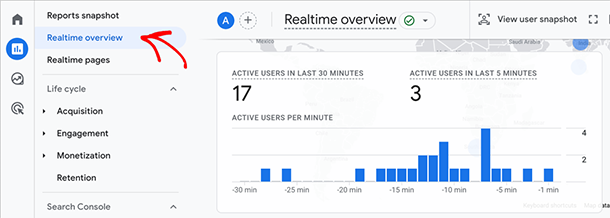
Google Analytics 4 Realtime Report

This shows you what’s happening on your site right now. It’s great for seeing immediate results from a new post or campaign.

User Attributes / Demographics
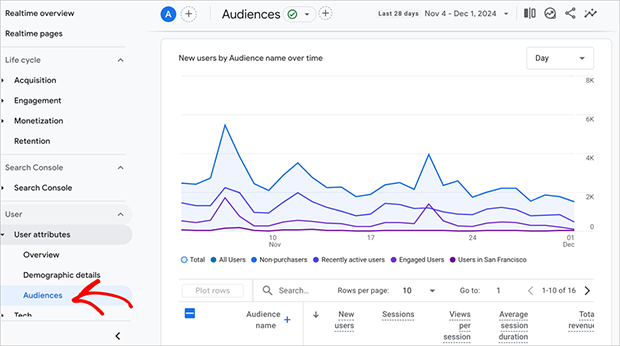
Google Analytics Audiences Report

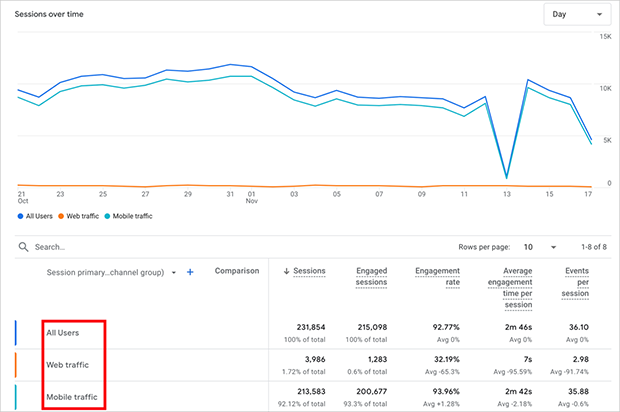
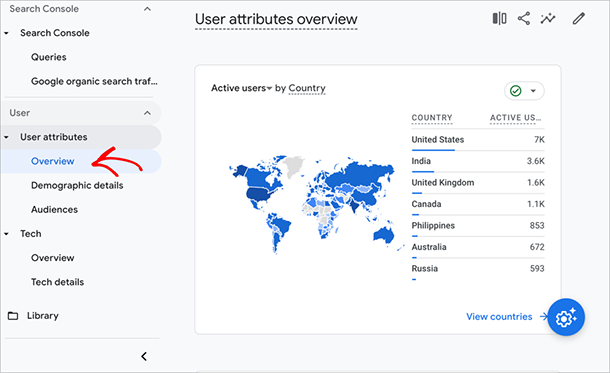
This report shows details about the people visiting your site. You’ll see info like their location, device type, and tech details. GA4 groups this under Users and Tech so it’s easier to understand who your audience is.

Acquisition Reports
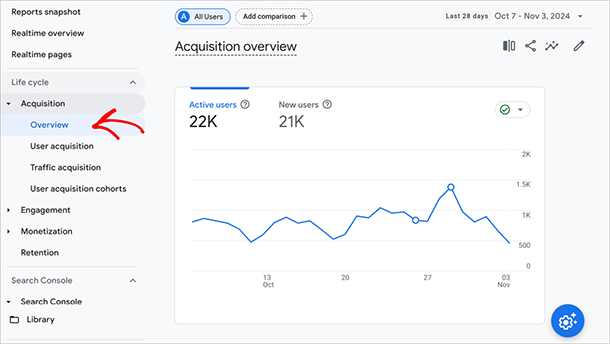
Google Analytics 4 Acquisition Report

These tell you how people are finding your site. Are they coming from Google searches, social media, or other websites?

Now, let’s look at how you can use this data:

  • See Top Traffic Sources: Find out which sites or platforms are sending you the most visitors. Maybe you’ll discover that Instagram is driving more traffic than you thought!
  • Understand User Behavior: See which pages people visit most and how long they stay. This can help you focus on your most popular content.
  • Track Conversions: Set up goals to track important actions on your site, like newsletter sign-ups or product purchases.
  • Measure Campaign Success: See how well your marketing efforts are paying off. You can track specific campaigns to see which ones bring in the most visitors or sales.

Remember, GA4 is powerful but can be complex. If you want to dive deeper, see our Easy Google Analytics 4 guide for a more detailed walkthrough.

And if you’re looking for a simpler way to see your key metrics at a glance, stay tuned – I’ve got a great solution coming up later in this article.

How to Add Google Analytics to Your Website

Now that you know why Google Analytics is so valuable, let’s get it set up on your website. Don’t worry – it’s easier than you might think.

Getting Your GA4 Tracking Information

Before we dive into adding the code to your site, you need to get two important pieces of information from Google Analytics:

  • Your Measurement ID: This is a unique identifier for your GA4 property. It always starts with “G-” followed by a series of numbers and letters (like G-XXXXXXXXXX).
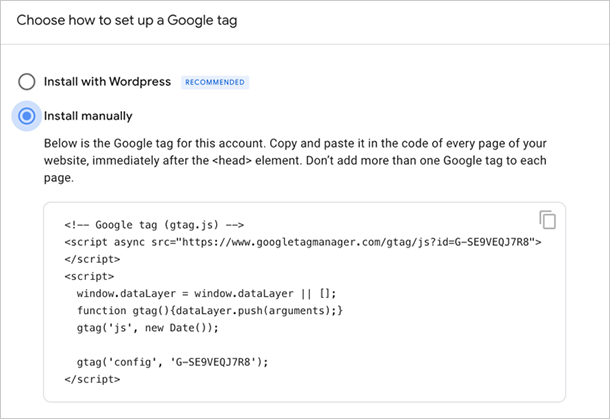
  • The global site tag (gtag.js) code snippet: This is a small piece of JavaScript code that you’ll need to add to your website. It looks like this:
<!-- Google Analytics -->

<script async src="https://www.googletagmanager.com/gtag/js?id=G-XXXXXXXXXX"></script>

<script>
  window.dataLayer = window.dataLayer || [];
  function gtag(){dataLayer.push(arguments);}
  gtag('js', new Date());
  gtag('config', 'G-XXXXXXXXXX');
</script>

Remember to replace ‘G-XXXXXXXXXX’ with your actual Measurement ID.

Note: For the platform methods below, like WordPress, Wix, and Shopify, you only need your Measurement ID (the one that starts with G-). You don’t paste the full gtag.js code snippet into those fields.

Now, let’s look at how to find these details.

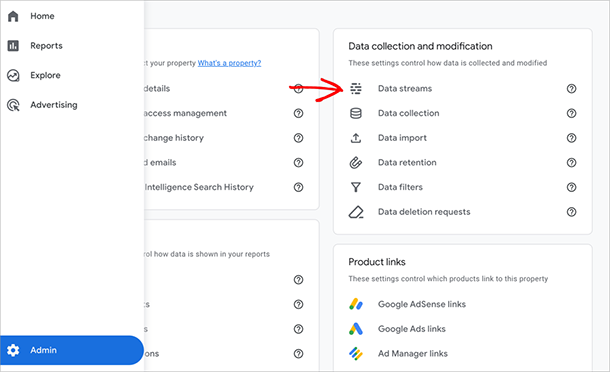
First, sign in to your Google Analytics account and go to the Admin section (look for the gear icon at the bottom left).
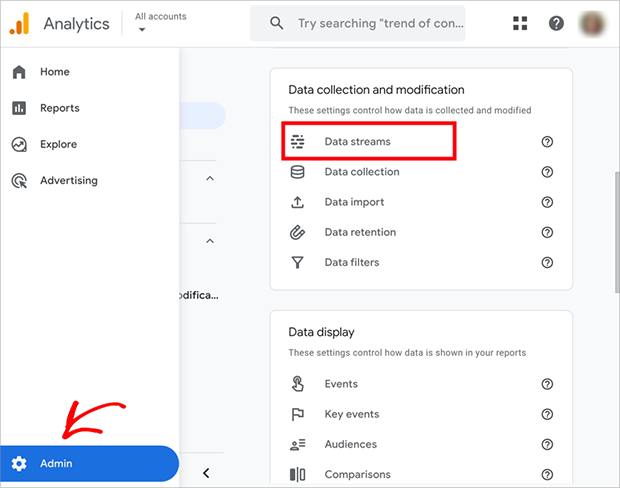
Google Analytics Data Streams

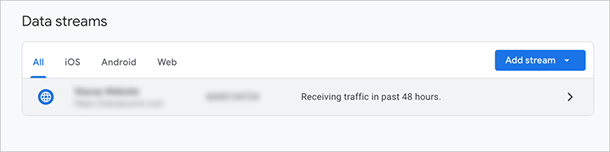
Now, in the Property column, click on “Data Streams” then, go ahead and select your website’s data stream.
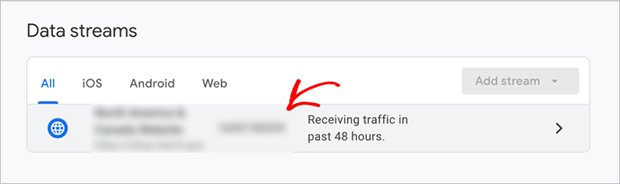
Website data stream in GA4

Here, you’ll see your Measurement ID at the top of the page.
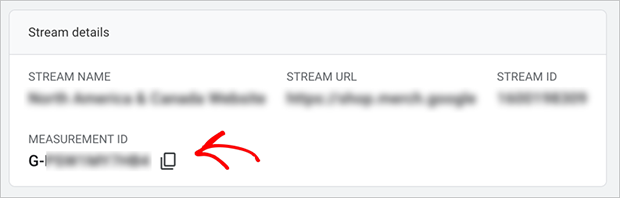
Google Analytics Measurement ID

To get the gtag.js code snippet, click on the “View tag instructions” option.
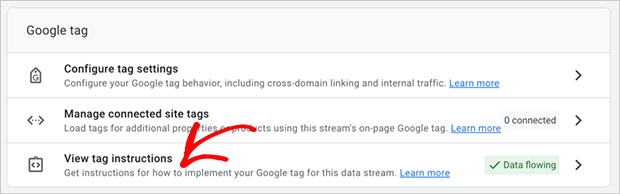
View tag instructions in GA4

From there, select “Install Manually”. You’ll see a box with some code, which is what you’ll need to add to your website.
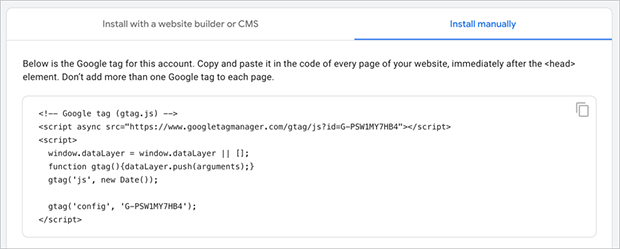
Gtag JavaScript code

Adding the GA4 Tracking Information to Your Website

Now that you have your GA4 tracking information, it’s time to add it to your website.

The general process involves adding the global site tag (gtag.js) code to the <head> section of your website’s HTML. This ensures that Google Analytics can track all pageviews and events on your site.

The exact method for adding this code can vary depending on the platform you’re using for your website. In the following sections, we’ll walk through how to add Google Analytics to some of the most popular website platforms.

Enhanced Measurement in GA4

Google Analytics 4 offers an “Enhanced Measurement” feature that automatically tracks additional events on your website without requiring any extra code.

This feature includes tracking for:

  • Page views
  • Scrolling
  • Outbound clicks
  • Site search
  • Video engagement
  • File downloads

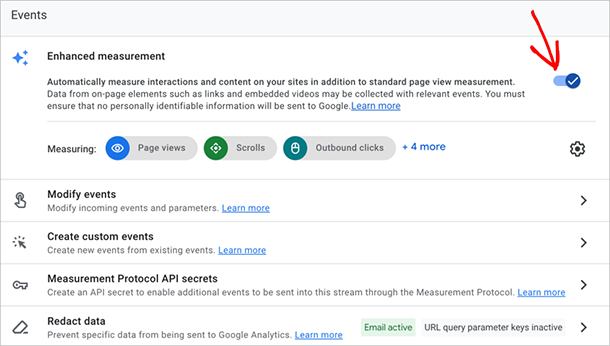
To verify Enhanced Measurement, go to Admin » Data Streams and select your website. It’s usually turned on by default, but it’s still good to double-check.
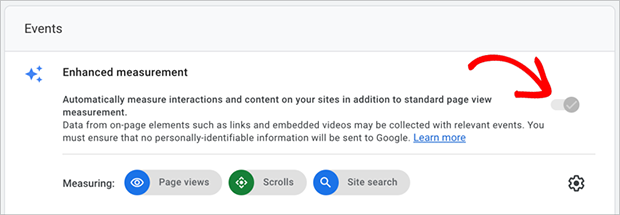
GA4 Enhanced Measurements Enabled

Enabling this feature ensures GA4 can track important events on your site automatically, giving you more detailed insights into user behavior.

How to Add GA4 to Popular Website Platforms

As I mentioned earlier, the exact method for adding this code can vary depending on the platform you’re using for your website. Let’s walk through how to add Google Analytics to some of the most popular website platforms:

Adding Google Analytics 4 to WordPress

WordPress powers over 43% of the web. Adding GA4 is simple, and I like using MonsterInsights because it handles the tracking code for you and stops double counting.
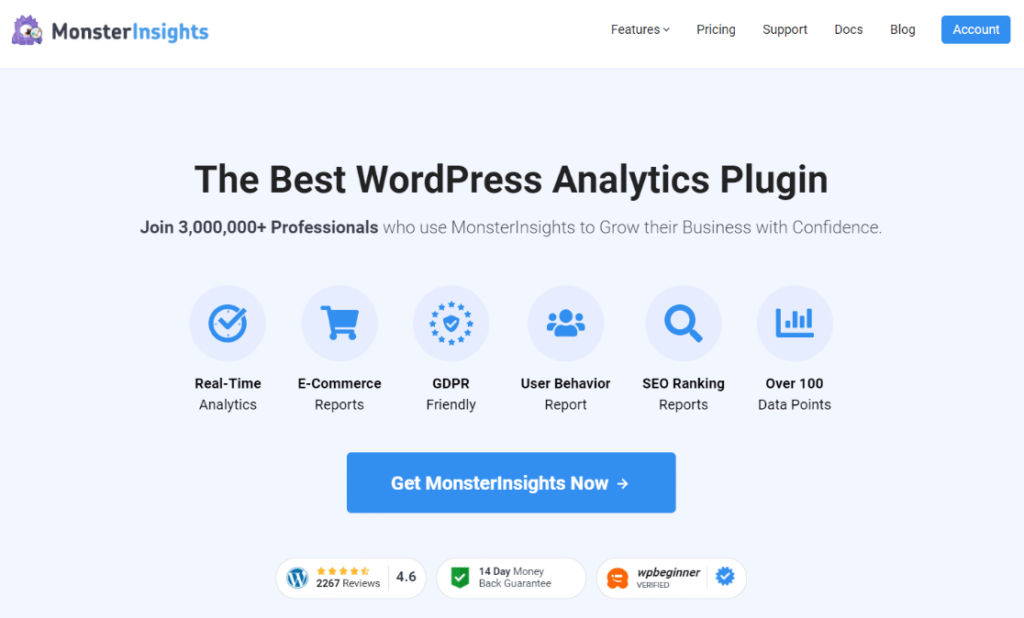
MonsterInsights WordPress Google Analytics plugin

With MonsterInsights, you never have to worry about adding your tracking code twice. The plugin automatically prevents double-tracking, which is a common mistake that can mess up your data.

How to Add GA4 Using MonsterInsights

To get started, you’ll need to install MonsterInsights.

Head over to the Plugins section in your WordPress dashboard, click “Add New,” and search for “MonsterInsights.”
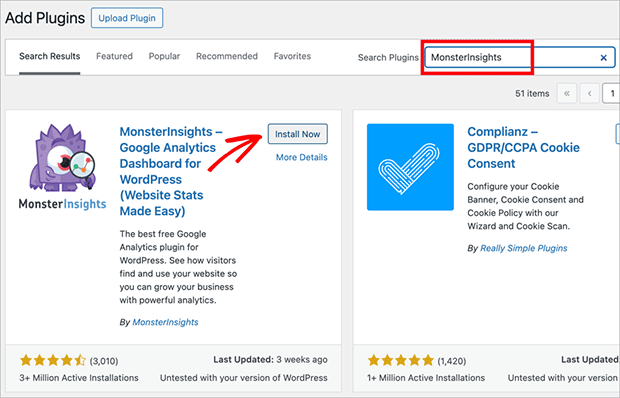
Install MonsterInsights plugin

Once you find it, just click “Install Now” and then “Activate.”
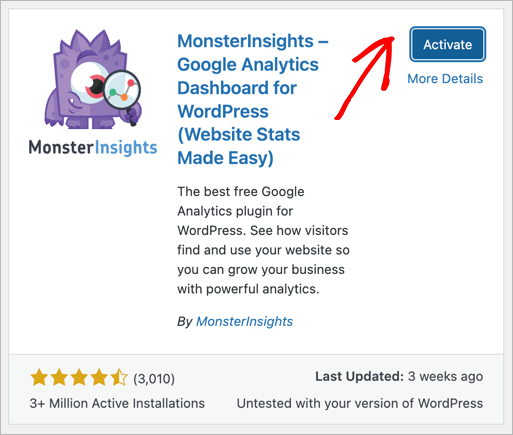
Activate MonsterInsights

After activation, you’ll see a welcome message with a “Launch the Wizard!” button. Click it to start the setup process.
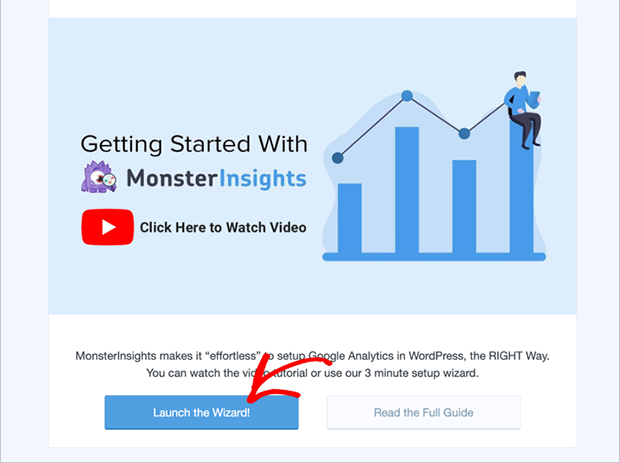
MonsterInsights launch wizard

The wizard will guide you through choosing your website category and connecting to Google Analytics.

MonsterInsights setup wizard: Category
MonsterInsights setup wizard: Site Category

When you reach the connection step, click “Connect MonsterInsights” and select the Google account you use for Analytics.
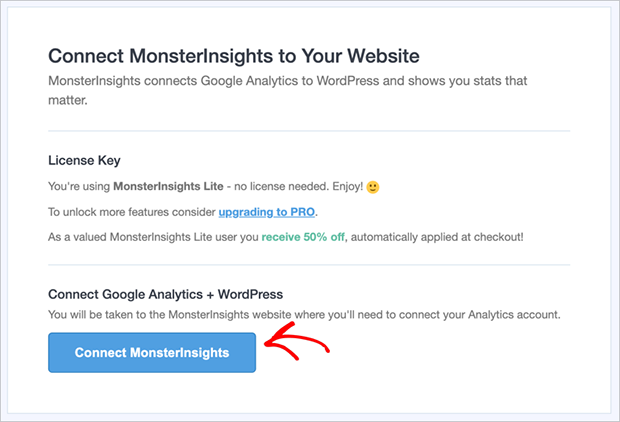
Connect MonsterInsights to GA4

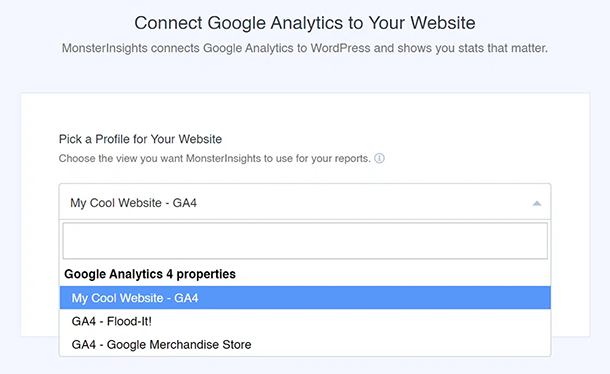
You’ll then be prompted to choose your GA4 property and the appropriate profile for your website.
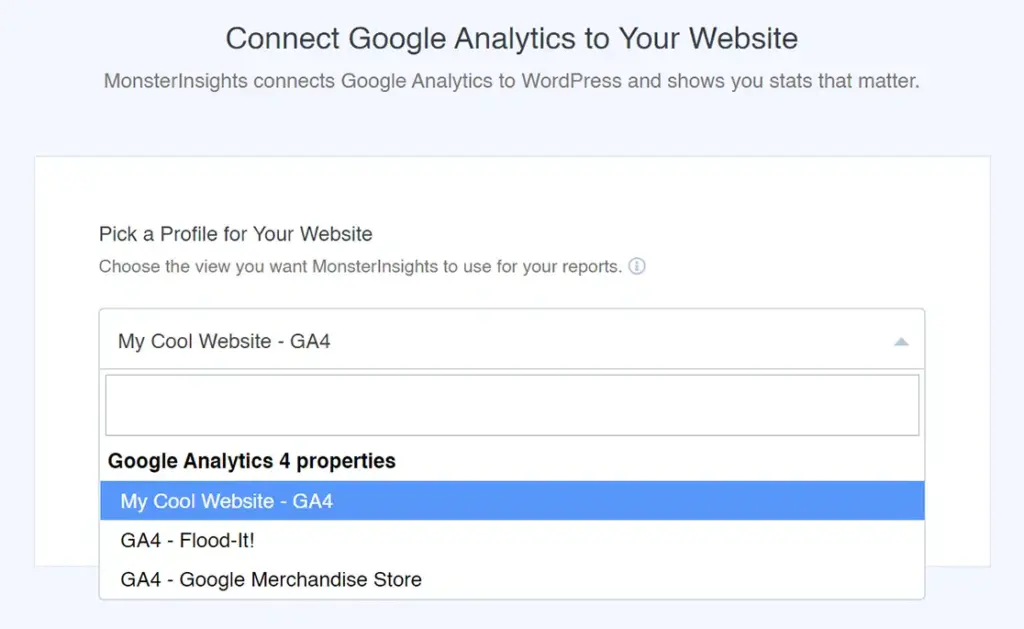
Choose your GA4 property

As you complete the setup, you’ll have the option to enable recommended settings or customize them to your liking.
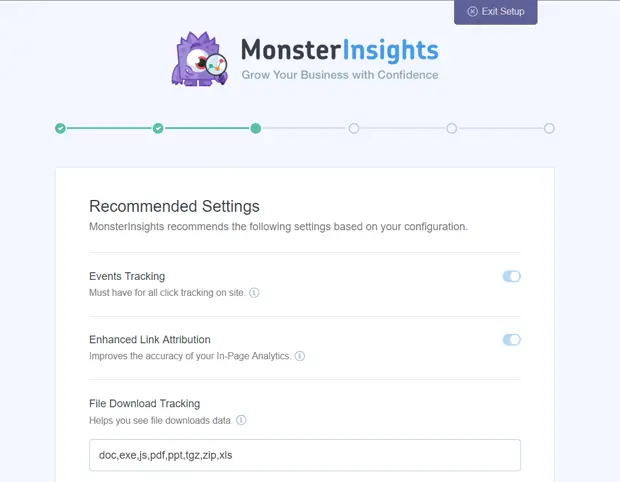
MonsterInsights recommended settings

Once you’ve finished, MonsterInsights will automatically add the necessary GA4 tracking code to all pages of your WordPress site.

To verify the connection, go to Insights » Settings in your WordPress dashboard. Under the “General” section, you should see your GA4 property listed.
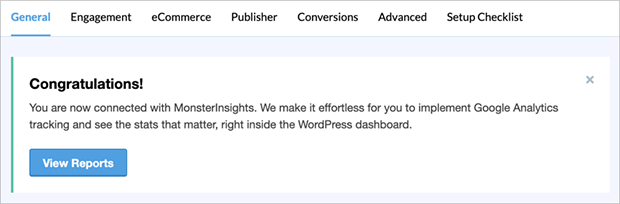
GA4 and MonsterInsights connection success message

Realtime data shows up right away. Other reports, like Acquisition or Engagement, can take 24 to 48 hours to update, so don’t worry if those sections look empty at first.

Remember, MonsterInsights offers both free and paid versions. The free version is great for getting started, but the paid version offers more advanced features if you need them.

Setting up Google Analytics 4 in Shopify

How to Add Google Analytics to Website: Shopify
Shopify

As an e-commerce powerhouse, Shopify knows the importance of good analytics. That’s why they’ve made adding Google Analytics 4 to your online store a straightforward process.

To get started, log in to your Shopify admin panel. Look for “Online Store” in the left sidebar and click on it, then select “Preferences.”

Scroll down the page until you spot the “Google Analytics” section. Here, click “Set up Google”.
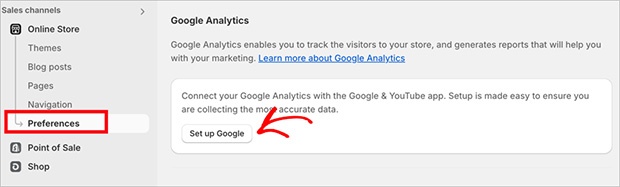
Set up Google in Shopify

You’ll now need to install the Google app, so go ahead and click the “Install” button.
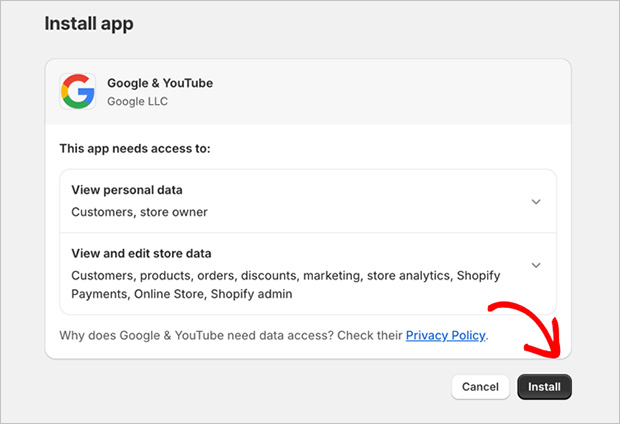
Install the Google app in Shopify

From there, connect the Google account you used to set up your Google Analytics profile.
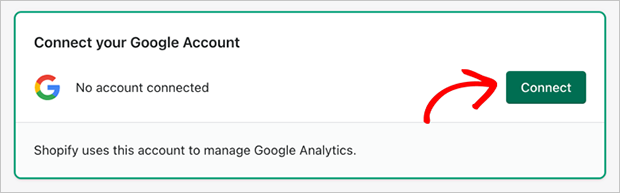
Connect Google account to Shopify

After, scroll down to the “Google Analytics” section, and you should see a dropdown box where you can choose your Analytics property. Select the appropriate property and click “Connect”.
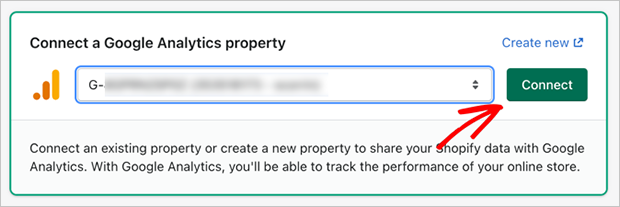
Connect Google Analytics property to Shopify

There you have it. You’ve successfully set up Google Analytics 4 on your Shopify store.
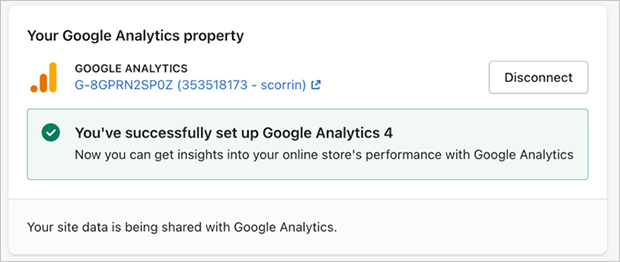
Shopify GA4 connection success message

Adding Google Analytics 4 to Squarespace

How to Add Google Analytics to Website: Squarespace
Squarespace

Squarespace is known for its sleek designs and user-friendly interface, and their approach to analytics integration is no different. Adding Google Analytics to your Squarespace site is a simple process that doesn’t require any coding.

First, log into your Squarespace account and navigate to the site you want to add GA4 to. Once you’re in, look for the “Settings” menu in the left sidebar.

Squarespace website settings menu

Click on Settings, then scroll down to Developer Tools. In some dashboard versions, you’ll find it under Website Tools.
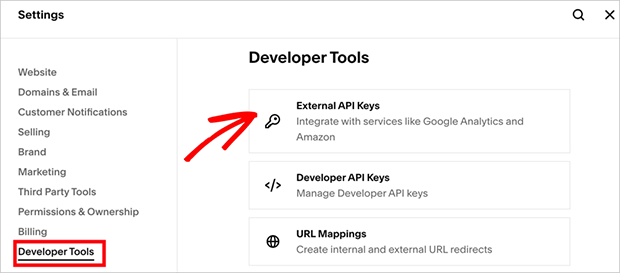
Squarespace external API keys

At the top of this page, click the “External API Keys” option.

Here’s where you’ll paste your GA4 Measurement ID. Remember, this is the one that starts with “G-”.
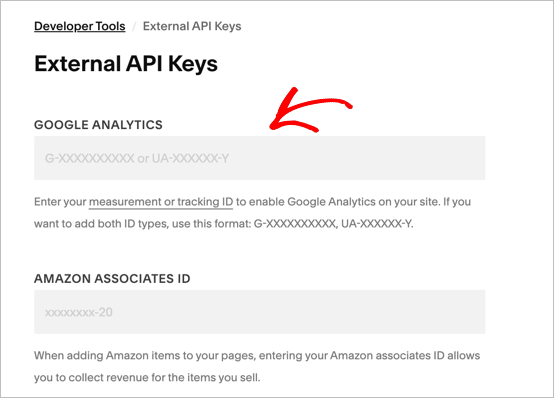
Add GA4 Measurement ID to Squaresapce

Squarespace will now start sending data to your GA4 property.

Once you’ve added your Measurement ID, don’t forget to enable Enhanced Measurement in your GA4 property, as explained earlier. This will ensure you’re getting the most out of your analytics setup.

And there you have it. You’ve successfully added Google Analytics 4 to your Squarespace site. 

Remember, it might take a day or two before you start seeing data in your GA4 reports, so don’t panic if you don’t see immediate results.

Connecting Google Analytics 4 to Wix

How to Add Google Analytics to Website: Wix
Wix

Wix allows millions of users to create stunning websites, and you can improve yours with robust analytics. The process of adding Google Analytics Wix is refreshingly simple.

First, log into your Wix account and head to the Dashboard for the site you want to add GA4 to. Look for the “Marketing & SEO” menu in the left sidebar and click on it.

Then, find and the “Google Analytics” option and click on “Connect Google Analytics”.
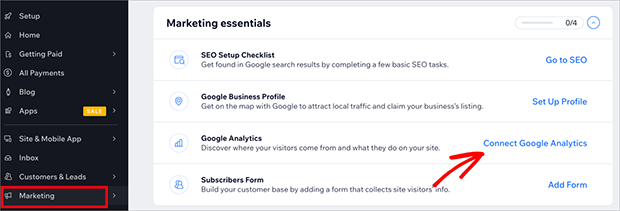
Connect Google Analytics to Wix

Wix will ask you to connect your account. So click the “Add Google Analytics ID” button.
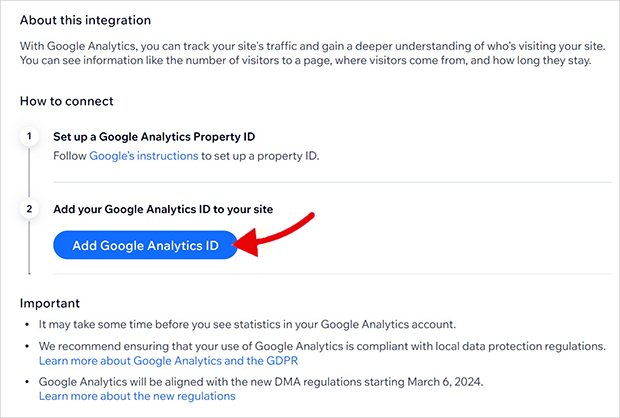
Add Google Analytics ID to Wix

Next, you’ll need to enter your GA4 Measurement ID. Paste your Measurement ID into the field and click “Save.”
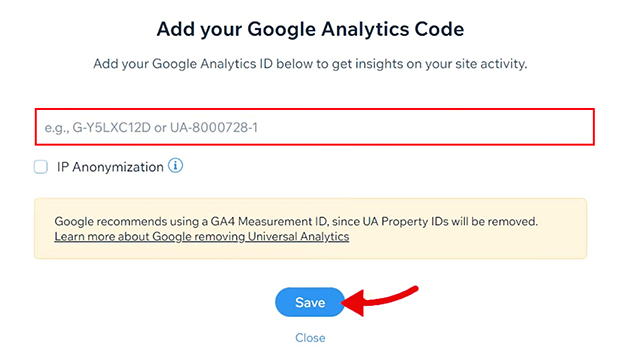
Add GA4 Measurement ID to Wix

Wix will now verify the connection with Google Analytics. Once the connection is verified, you’ll see a success message.

And that’s it. Wix will now start sending data to your GA4 property.

Enabling Google Analytics 4 in Webflow

How to Add Google Analytics to Website: Webflow
Webflow

For those who love design flexibility with the convenience of a visual interface, Webflow is a go-to platform. Adding Google Analytics 4 to your Webflow site is as smooth as the platform’s drag-and-drop interface.

First, log into your Webflow account and from your dashboard click the Settings icon on your chosen website project.
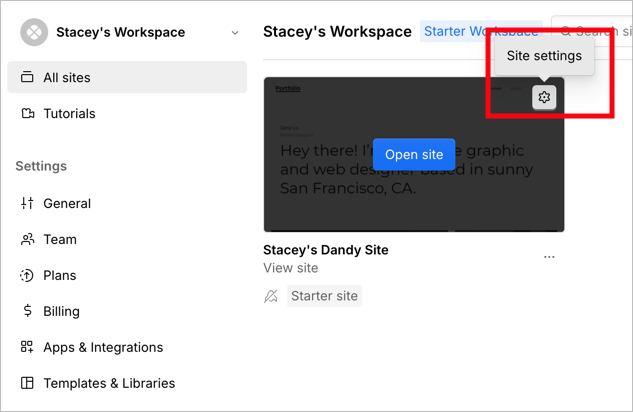
Webflow project settings

Next, click the “Apps & Integrations” option in the left-hand sidebar. On this page, find the Google Analytics heading.

Here, you’ll find a field labeled “Measurement ID.” So, go ahead and paste your Google Analytics Measurement ID into this box.
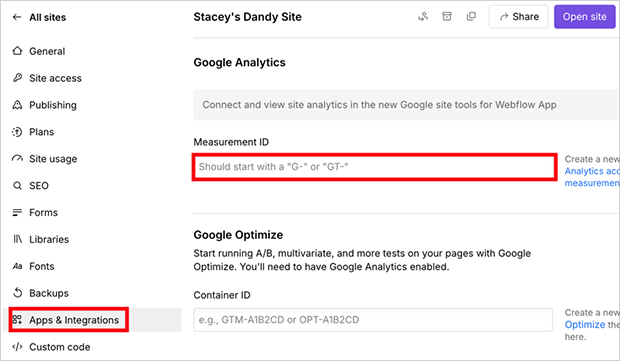
Add Measurement ID for GA4 to Webflow

Once you’ve added your ID, click “Save” at the top of the page. Webflow will now start sending data to your GA4 property.

And there you have it! You’ve successfully added Google Analytics 4 to your Webflow site. 

Testing and Verifying Your GA4 Setup

Great job on setting up Google Analytics 4. But before you pop the champagne, let’s make sure everything’s working as it should.

First, head over to your GA4 property and click on “Reports” in the left sidebar.

Then, select “Realtime Overview” at the top. This report shows you what’s happening on your site right now.
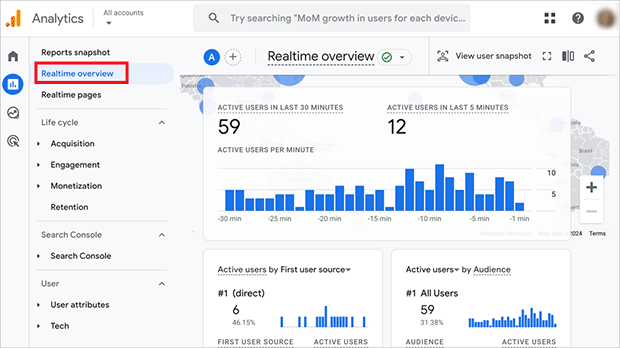
GA4 Realtime Overview report

To test it out, open your website in a new tab and navigate around a bit. You should see your activity appear in the Real-time report within a few seconds.

If you do, congratulations. Your basic tracking is up and running.

But what if you’re not seeing any data? Don’t panic! Here are a few things to check:

  • Make sure you’re looking at the right property in GA4.
  • Double-check that you’ve added the correct Measurement ID to your website.
  • If you’re using a caching plugin on WordPress, try clearing the cache.

For more advanced setups, you’ll want to verify that your events and conversions are tracking correctly. You can do this by setting up some test events and checking if they appear in your Google Analytics reports.

If you’re still having trouble, Google’s troubleshooting guide is a great resource.

Using Google Tag Manager (Optional)

If you’re looking to take your analytics game up a notch, Google Tag Manager (GTM) might be just what you need. It’s like a Swiss Army knife for website tracking, and it plays nicely with Google Analytics 4.

You might be wondering, “Why bother with another tool?” Well, GTM has some pretty cool benefits:

  • Code Management: Instead of cluttering your site with various tracking codes, GTM lets you manage all your tags in one place. It’s like having a tidy toolbox for all your analytics needs.
  • Advanced Tracking: Want to track specific button clicks or form submissions? GTM makes it easy to set up custom events without touching your website’s code.
  • Quick Updates: Need to add or change a tracking pixel? With GTM, you can do it in minutes, without waiting for your web developer to make changes.
  • Improved Site Speed: GTM is designed to load your tags efficiently, which can help keep your site running smoothly.

To get started, you’ll need to create a GTM account and container.
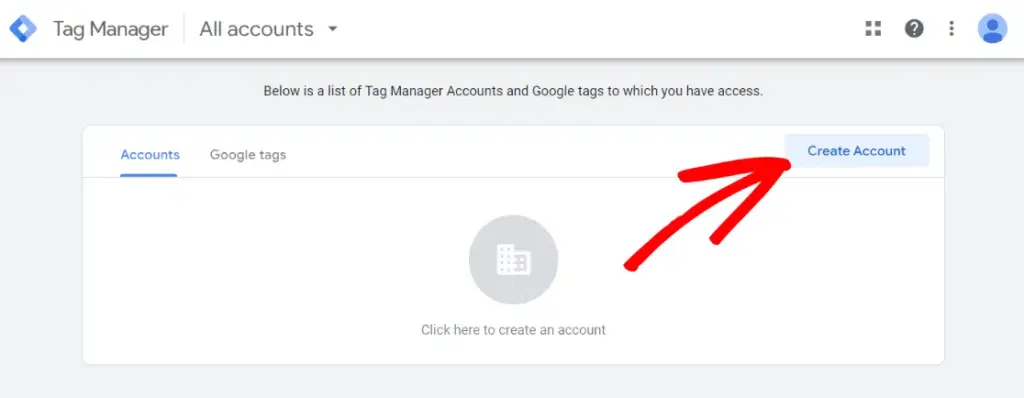
Create a Google Tag Manager Account

Think of the container as a bucket for all your tags.
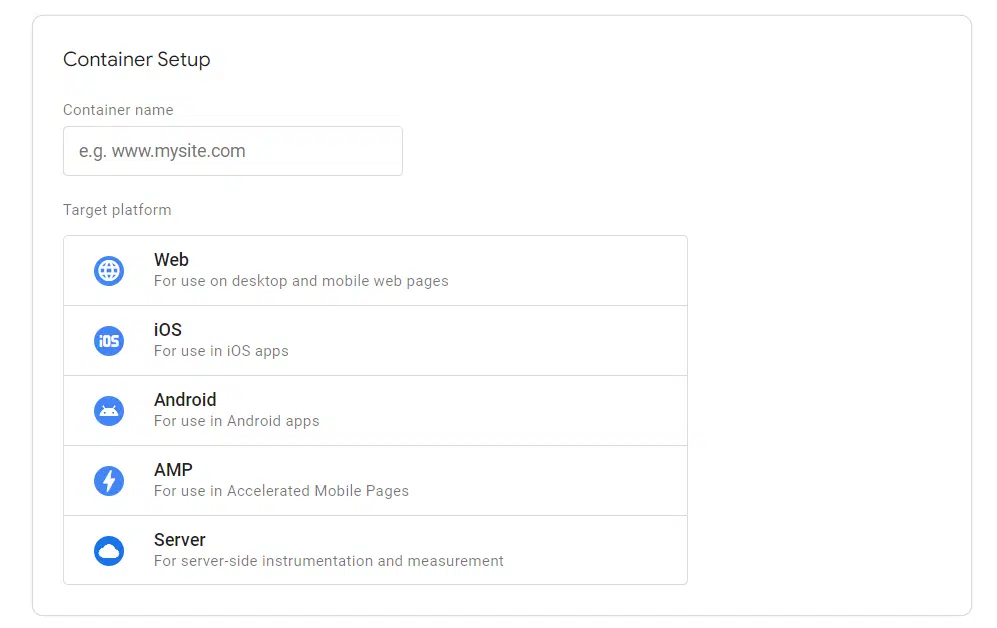
Google Tag Manager Container setup

Once you’ve set up your container, you’ll add the GTM code to your website. This code goes on every page, similar to the GA4 tag.
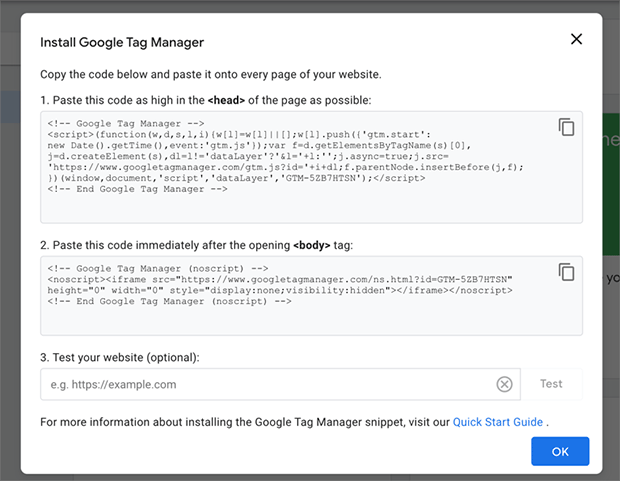
Google Tag Manager code

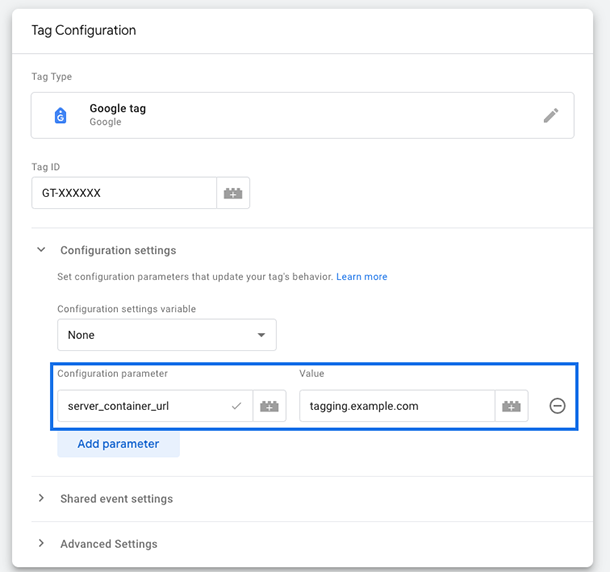
Next, you’ll set up a Google Tag in GTM. Choose the “Google Tag” option and enter your Tag ID, also called your Measurement ID, in the configuration field.
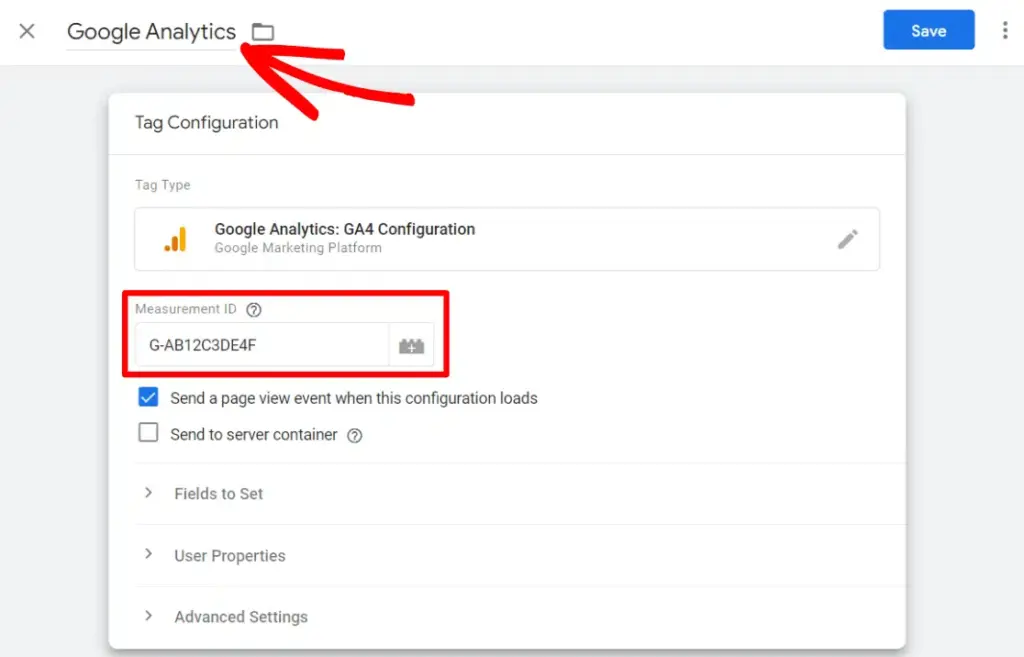
Google Analytics tag configuration

Finally, you’ll create a trigger to fire your GA4 tag on all pages.

Trigger GTM on all pages

Once you’ve got GTM set up, you can start adding more advanced tracking. Want to see how far people scroll down your pages? Or track when people click on your “Contact Us” button? GTM makes all of this possible without needing to edit your website’s code directly.

If you’re interested in learning more about setting up GTM with GA4, Google has some great resources:

Remember, while GTM can be super powerful, it’s also more complex than a basic GA4 setup. If you’re just getting started with analytics, you might want to stick with the standard GA4 installation for now. You can always add GTM later when you’re ready to dive into more advanced tracking.

A Simpler Way to View Your GA4 Data

Congratulations on setting up Google Analytics 4. You’ve taken a big step towards understanding your website and audience better.

While GA4 is powerful, it can be overwhelming. This is where that solution I mentioned earlier comes in: OnePageGA.
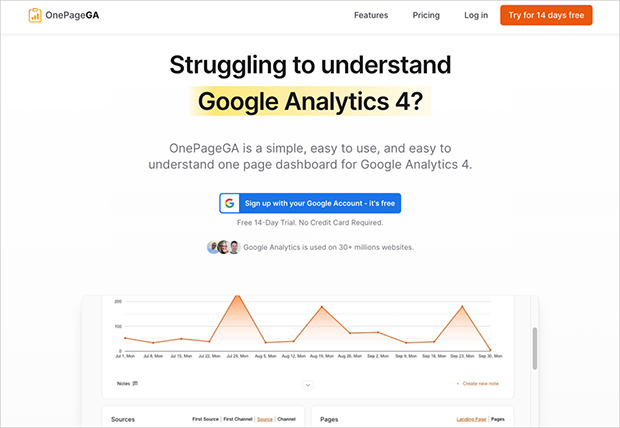
OnePageGA Simple One Page GA4 Dashboard

It’s designed to simplify your GA4 data, presenting key metrics like total visitors, top traffic sources, and most popular pages on a single, easy-to-read dashboard.
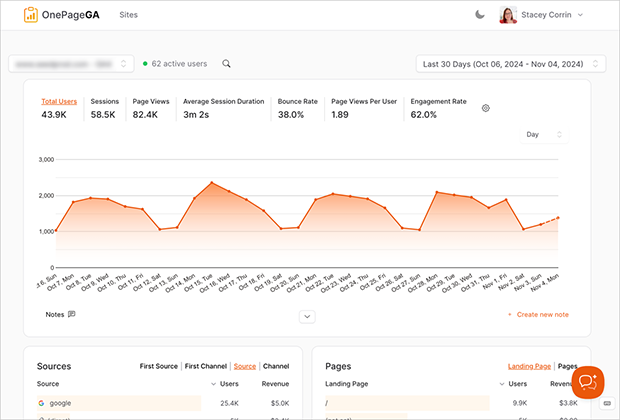
OnePageGA Dashboard
OnePageGA Dashboard

Remember, the goal of analytics is to help you make smarter decisions about your website. Don’t get lost in complex features – focus on the data that matters most for your goals.

If you’re finding GA4 challenging or just want a more streamlined approach, give OnePageGA a try. It could be the tool you need to make sense of your data without the headache.

Ready to simplify your analytics?

Start your free OnePageGA trial today.

Frequently Asked Questions

Is Google Analytics free for my website?

Yes. Google Analytics 4 is free for websites and apps. Most site owners never need the paid version.

How do I know if I have Google Analytics on my website?

You can check this in a few ways. The easiest is to open your site, right click, and choose View Page Source. Look for a code that starts with “G-”. You can also use a browser extension that scans your site for analytics tags.

Can I use Google Analytics on any website?

Yes. You can add GA4 to any website, whether it’s built with WordPress, Shopify, Wix, Squarespace, Webflow, or custom code. As long as you can paste the Measurement ID or add the GA4 script, it will work.

You may also find the following GA4 tutorials helpful:

If you have questions or want to join the conversation, you can also find us on X and Facebook.
Is Google Analytics 4 Worth It? The Pros and Cons

Posted on -

Written By: author avatar Stacey Corrin

If you’re weighing the google analytics 4 pros and cons, the verdict is clear: the platform offers incredible data depth, but it’s difficult to master.

In fact, many website owners struggle just to find their basic traffic stats inside the new interface.

That’s why I recommend using OnePageGA if you want the insights without the hassle.

It connects to your account and turns that complex stream of data into a simple, one-page dashboard you can understand in seconds.

In this guide, I’ll break down the specific benefits and drawbacks of GA4 to help you decide if it’s worth the learning curve.

What Is Google Analytics 4 (GA4) & Why’s It Different?

Google Analytics 4 (GA4) is an event-based tracking platform that measures user behavior across both websites and mobile apps. It replaces the old Universal Analytics by focusing on customer lifecycles and privacy-compliant data collection rather than just simple pageviews.

Google Analytics 4 pros and cons

Before we look at the specific pros and cons of Google Analytics 4, it’s important to understand why this shift happened.

Google designed this new system to better track users in a world without cookies.

However, this new power comes with a trade-off.

Here is a quick look at how GA4 compares to the version you might remember:

FeatureOld Google AnalyticsGoogle Analytics 4What This Means for You
FocusVisits and sessionsIndividual usersYou see the person, not just the device
TrackingMainly page viewsEvents (Actions)Setup is more technical and manual
PrivacyRelies on cookiesMachine LearningWorks better with strict privacy laws
ReportsPre-made reportsCustom reportsYou must build reports from scratch
InsightsLimitedAI-poweredPredictions help if data is missing

Google Analytics 4 Pros and Cons

To help you decide if this update is right for you, I’ve tested GA4 extensively on my own projects. The main trade-off here is simple: you get much better data, but it takes a lot more effort to access it.

What Are the Pros of Google Analytics 4?

First, I’ll look at the specific benefits of using GA4 for your business.

1. Combined Web and App Tracking

GA4 tracks your website and mobile app data in a single property, which is a massive upgrade for businesses that use both.

Previously, you had to juggle separate properties and try to piece the data together yourself. Now, you can see exactly how people move between platforms.

Website and app traffic in Google Analytics 4

For example, you might discover that customers who use your app and your website spend 20% more than those who use just one. This insight helps you focus your marketing budget where it actually counts.

2. Deeper Engagement Insights

GA4 replaces the outdated “Bounce Rate” with a smarter metric called “Engagement Rate.”

This change finally gives content creators credit for visitors who actually read their articles.

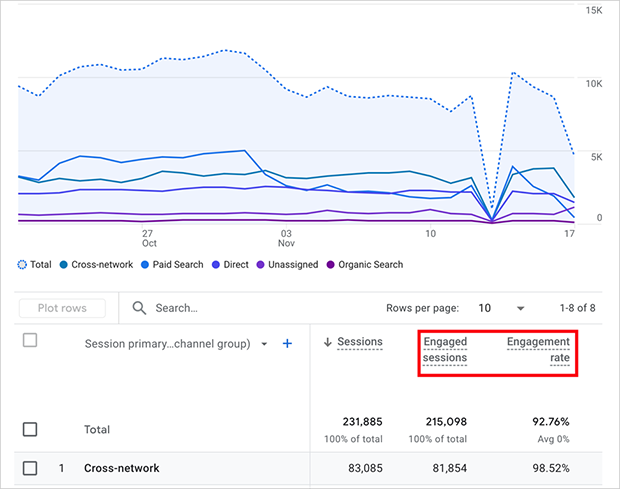
Technically, an engaged session occurs when a user spends at least 10 seconds on your site, views more than one page, or triggers a conversion event.

Engagement rate and engaged sessions in GA4

This distinction is vital for accurate reporting.

For instance, if someone reads your blog post for five minutes and then leaves, the old system called that a “bounce” (a failure). GA4 correctly identifies that user as an interested reader.

3. AI-Powered Predictions

One of the most futuristic features in GA4 is its ability to use artificial intelligence to predict user behavior.

This is incredibly helpful because privacy laws now block many traditional tracking cookies.

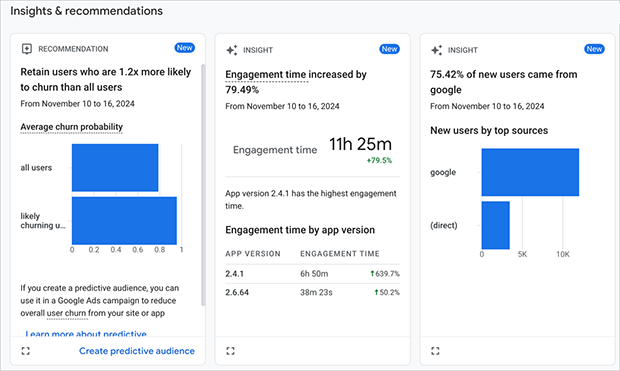
AI powered insights in Google Analytics 4

When data is missing, GA4’s AI steps in to fill the gaps, ensuring your reports remain accurate even when users opt out of tracking.

Even better, it can predict future actions.

For example, the Purchase Probability metric estimates which users are likely to buy from you in the next seven days. This allows you to run targeted ads specifically to people who are ready to spend money.

4. Free Enterprise-Grade Tools

Perhaps the biggest advantage is that Google gives away this powerful technology for free.

Google Analytics is free for everyone.
#image_title

In the past, features like raw data export and BigQuery integration cost big companies over $150,000 per year. Now, your small business can use the exact same tools as the Fortune 500.

However, keep in mind that “free” only applies to the monthly subscription fee.

The real cost is the time you’ll spend learning how to configure these advanced settings. While you save money, you might pay for it in setup hours.

5. Flexible Event Tracking

GA4 completely changes how we track user actions by treating everything as an “event.”

This means you aren’t limited to just counting how many times a page loads.

Instead, you can measure specific interactions like button clicks, file downloads, or video views without needing complex code.

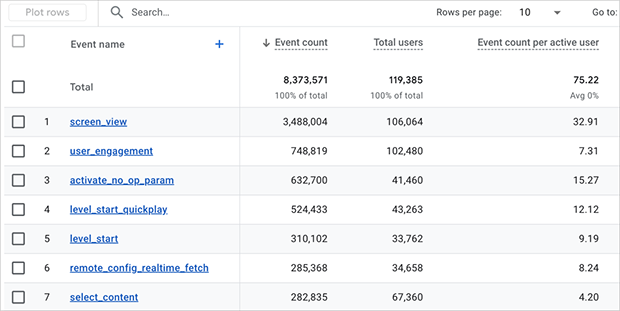
Event tracking report in Google Analytics 4

For example, if you ran a music site, you could track:

  • Song plays
  • Playlist creations
  • Social shares
  • Account upgrades

This flexibility allows you to build a tracking strategy that actually fits your specific business model.

6. Advanced Analysis with BigQuery

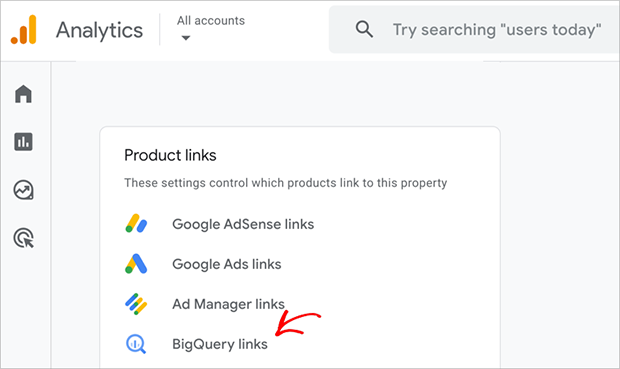
For those who want to dig deep, GA4 offers a free connection to BigQuery, a tool for analyzing massive datasets.

This allows you to export your raw data and run complex queries that the standard dashboard simply can’t handle.

BigQuery Product links in Google Analytics 4

Here is how this helps your business:

  • No Data Sampling: You can look at all your data, not just a random sample that Google selects.
  • Longer Retention: BigQuery lets you save your historical data forever, overcoming GA4’s standard retention limits.
  • Combined Sources: You can mix your website traffic data with your internal sales data (CRM) to see the full picture.

While this requires technical SQL knowledge, it opens up a world of possibilities for advanced marketers.

7. Direct Marketing Integrations

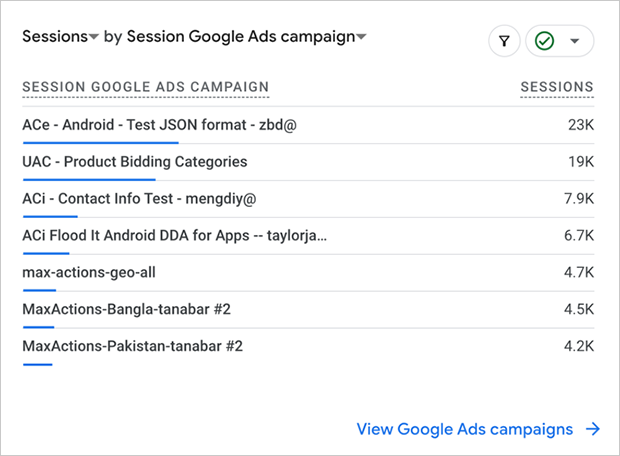
GA4 connects seamlessly with Google Ads to make your marketing campaigns significantly smarter.

Google Ads campaigns in GA4

This integration allows you to see exactly which ads are driving actual revenue, rather than just clicks.

One of the most powerful features here is the ability to create “Custom Audiences.”

For instance, you can group users who visited your pricing page but didn’t buy. Then, you can automatically show a targeted ad specifically to that group to win them back.

For a deeper dive into these features, check out our guide on Easy Google Analytics 4: A Simple Guide on How It Works.

What Are the Cons of Google Analytics 4?

While GA4 has many great features, it also has some downsides. Having used it on various websites, I’ve run into some issues that you should know about.

These problems aren’t deal-breakers, but they can be frustrating if you aren’t ready for them.

1. Steeper Learning Curve

One of the biggest challenges with GA4 is that it’s completely different from the old Google Analytics.

Instead of simply counting page views, GA4 focuses on ‘events’ to understand how people really use your site.

While this gives you better data, it forces you to relearn how to find basic information.

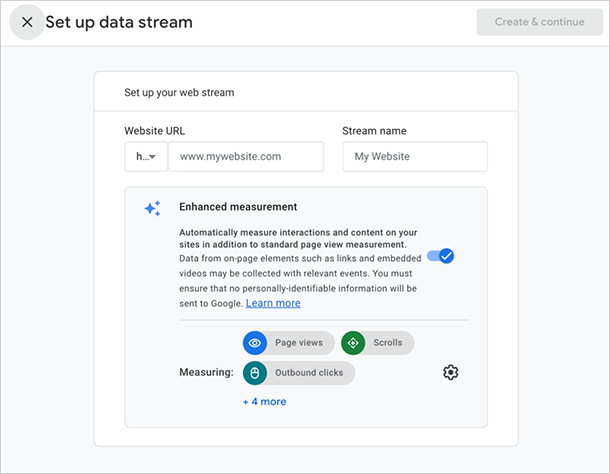
Setting up a data stream in GA4

However, tools like OnePageGA solve this problem instantly.

Because OnePageGA handles the technical tracking for you, you don’t need to learn the complex event-based model just to see who is visiting your site.

2. Limited Historical Data

Another challenge is that you can’t see your old data from Universal Analytics (UA) inside GA4. This makes it difficult if you want to compare this year’s traffic with last year’s numbers.

Unfortunately, there isn’t an easy fix for this inside Google’s platform.

But there are ways to deal with this:

  • Export your old data: If you saved your UA data before it disappeared, you can keep it in a spreadsheet for reference.
  • Start fresh: Focus on collecting accurate data in GA4 starting today.
  • Look forward: Use your first year of GA4 as a new baseline to compare future growth against.

Losing your history is tough, but as you build up new data, it will matter less.

3. Less Developed Reporting Interface

Many people find GA4’s reports harder to use than the old Google Analytics.

In the past, you could easily find common reports like “Bounce Rate” or “Traffic Sources” right in the sidebar. In GA4, these reports often look different or require you to build them yourself as “custom reports.”

Custom reports in Google Analytics 4

This means you have to dig around more just to find the basic information you want.

That’s why I prefer using OnePageGA for my daily reporting.

Instead of digging through menus to build a custom view, OnePageGA gives you a pre-built dashboard that shows your most important metrics immediately.

While Google is working to improve the interface, OnePageGA is the fastest way to get your data right now.

GA4 and Privacy: A Double-Edged Sword

GA4 takes a strict approach to privacy, which protects your business legally but limits the data you can see. That’s the main trade-off you need to accept.

According to the Google Analytics Data Controls Guide:

Rising consumer expectations and changing industry regulations have set higher standards for user privacy and data protection.

One major shift is that GA4 relies much less on cookies. Instead, it uses machine learning to fill in the gaps when users opt out of tracking.

Here is how this privacy-first approach impacts you:

Benefits of GA4’s Privacy ApproachLimitations of GA4’s Privacy Approach
Provides useful visitor information even without cookiesLess detailed information about individual users
Better compliance with new privacy lawsHarder to track specific user journeys
Gives users more control over their data, building trustSome reports may not show data if there aren’t enough users
Slight differences in numbers due to data estimation

To work with these limitations, you’ll need to focus on broad trends rather than chasing individual user paths.

Do You Really Need All That Data?

GA4 offers endless data points, but most businesses only need a handful to grow. In reality, you might be drowning in data you’ll never actually use.

Do you really need to track every specific scroll depth? Or do you just need to know traffic sources and conversion rates?

This is where OnePageGA helps.

OnePageGA Simple One Page Google Analytics Dashboard

Its simple analytics dashboard turn complex GA4 data streams into simple, actionable insights.

OnePageGA gives you the power of Google’s tracking engine without the headache:

  • No-Code Setup: You can install it in under 2 minutes without touching a line of code.
  • Instant Overview: Understand your site’s performance in under 60 seconds.
  • Visual Clarity: See all your key metrics on a single screen.

It’s the best way to keep your analytics simple.

OnePageGA Simple single page Google Analytics 4 dashboard report

Is Google Analytics 4 Worth It for You?

So, is Google Analytics 4 worth the effort? In short: yes, because it’s the industry standard.

If you want to track ROI effectively and future-proof your business, you need to use it. But you don’t have to deal with the clunky interface if you don’t want to.

You can have the best of both worlds.

Use GA4 for the heavy lifting and data collection. Then, use OnePageGA to view that data without the headache. This setup gives you powerful tracking with a simple interface.

To simplify your analytics but still get the benefits of GA4, try OnePageGA free for 14 days to see if it works for you.

Frequently Asked Questions About GA4

Is Google Analytics 4 free?

Yes, the standard version of GA4 is completely free to use.

There is a paid version called Google Analytics 360, but that is designed for massive enterprise companies with huge data needs.

For most businesses, the free version is more than enough.

Can I still use Universal Analytics?

No. Google officially stopped processing data for Universal Analytics properties on July 1, 2023. If you want to track your website traffic today, you must use GA4 or a third-party alternative.

Is GA4 harder to use than the old version?

For most users, yes. Because it uses a new “event-based” model, many of the simple reports you were used to are gone or hidden.

If you find the new interface confusing, we recommend using OnePageGA to simplify the dashboard while keeping the powerful tracking of GA4 running in the background.

Is Google Analytics 4 GDPR compliant?

GA4 is designed to be more privacy-friendly than its predecessor. It does not log IP addresses and relies less on cookies.

However, “compliance” often depends on how you configure it and where your business is located. You should always consult with a legal expert for your specific situation.

You may also find the following GA4 guides helpful:

If you have questions or want to join the conversation, you can also find us on X.

Easy Google Analytics 4: A Simple Guide on How It Works

Posted on -

Written By: author avatar Stacey Corrin

In this guide, I’ll make easy Google Analytics a reality for you. You will learn exactly how the platform works, how to set it up, and how to quickly get the insights you need to grow your business.

Put simply: Google Analytics 4 works by using a unique tracking ID to record how visitors interact with your site. To set it up, you just need to create a free Google account, generate your “G-” tracking code, and add it to your website’s header.

What Exactly Does Google Analytics Do?

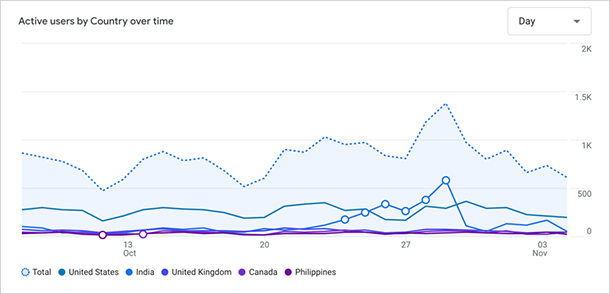
Google Analytics shows you what people are doing on your website. It tells you where they come from (like Google Search, Facebook, or other websites), what device they’re using (computer, phone, or tablet), and where they’re located.

Google Analytics active users by country over time

GA4 also tracks what pages they visit, how long they stay on each page, and if they do things like fill out a form or buy something. Basically, it helps you understand how people use your website so you can make it better.

How to Use Google Analytics 4

Many website owners find the amount of data in GA4 overwhelming. The platform has a steep learning curve, and the interface can be complex for beginners.

However, once you know where to look, GA4 is a valuable asset for your business. In this tutorial, I will simplify the setup process and show you exactly what to focus on.

Let’s dive in.

Step 1. Create a Google Analytics Account

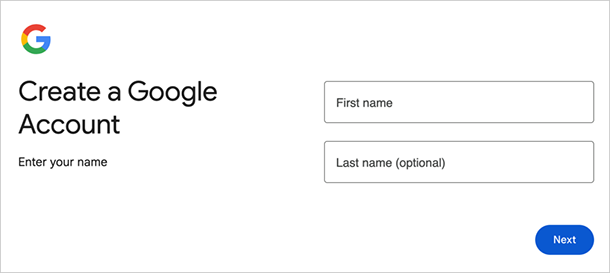
First, you’ll need a Google account. If you already use Gmail, Drive, or any other Google service, you’re good to go. If not, head over to accounts.google.com and create one. It’s quick and free.

Create a free Google account

Next, visit the Google Analytics website and click the “Start measuring” button. From there, follow these steps to configure your account:

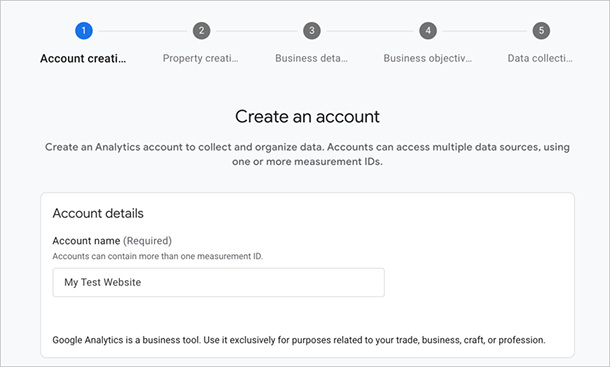
  1. Account Name: Enter your business or website name. Configure the data-sharing settings and click Next.
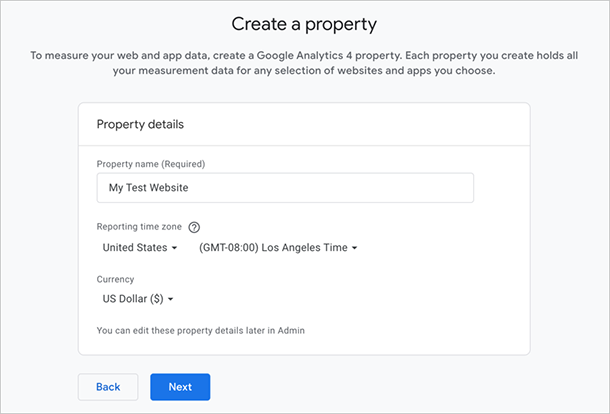
  2. Property Name: Enter your website name again. Select your reporting time zone and currency.
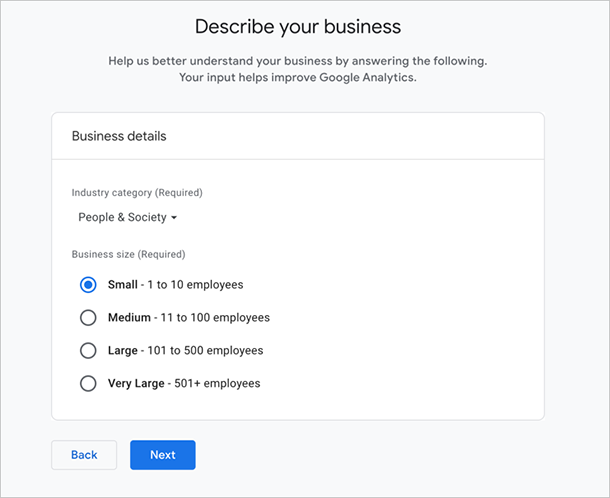
  3. Business Details: Select your industry category and business size.
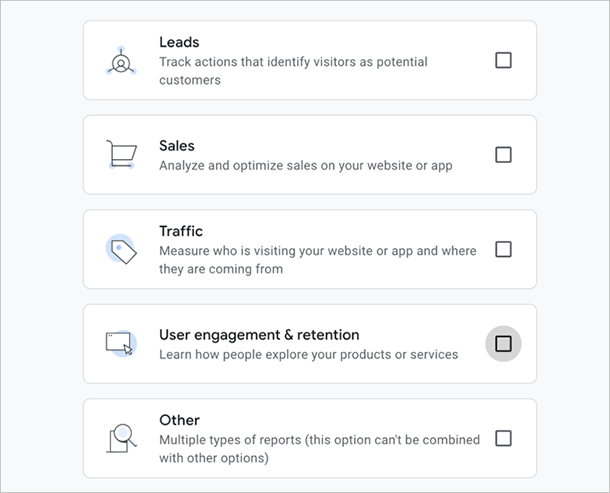
  4. Business Objectives: Choose what you want to achieve (Leads, Sales, Traffic, or User Engagement). This tailors your reports.
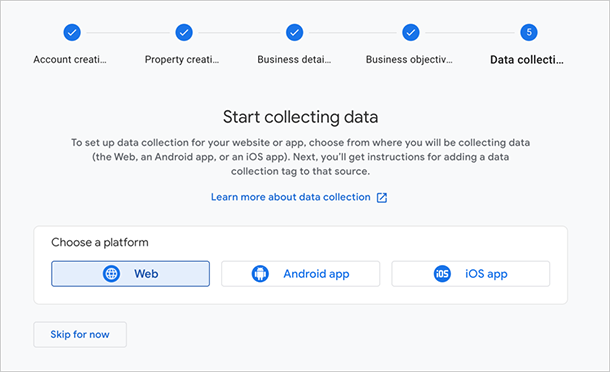
  5. Platform: Select “Web” to set up tracking for a website.

From there, you’ll need to enter your website’s URL and name. Once you’ve done this, click “Create and Continue”.

Step 1. Create a Google Analytics Account

First, you’ll need a Google account. If you already use Gmail, Drive, or any other Google service, you’re good to go. If not, head over to accounts.google.com and create one. It’s quick and free.

Create a free Google account

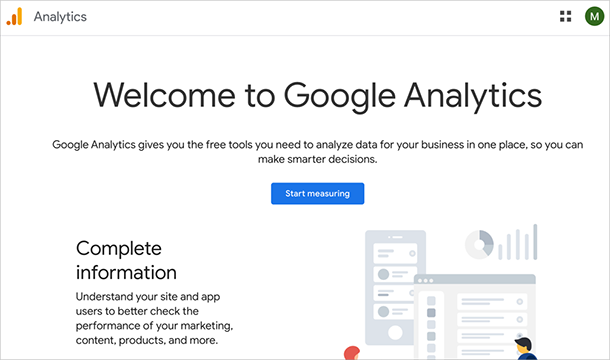
Next, visit the Google Analytics website and click the “Start measuring” button.

Click Start Measuring to sign up for Google Analytics

You’ll be asked to name your account (usually your website name) and set your account data-sharing settings before clicking next.

Enter your Google Analytics account name

Then, enter your property name (such as your site’s name), time zone, and currency.

Google Analytics property name, time zone, and currency settings

After this, Analytics will ask for your business industry and size.

Set your business industry and size in Google Analytics

The next screen asks you to choose your business objectives. This will help tailor your reports to the metrics that matter most to your business.

Set your Business Objectives in Google Analytics

Here, you can select any of the following:

  • Leads
  • Sales
  • Traffic
  • User engagement & retention
  • Other

The last step is to choose a platform to collect data from. Since you’re setting up Google Analytics for a website, click the “Web” option.

Collect data for a web platform in Google Analytics

From there, you’ll need to enter your website’s URL and name. Once you’ve done this, click “Create and Continue”.

Set Up a data stream in Google Analytics with your website URL and Stream name

Google will now provide you with a unique tracking ID, a string of characters that starts with “G-.” This ID tells Google which website to track.

Google Analytics tracking code

You’ll need to add this tracking ID to your website, which I’ll go into in more detail next.

Step 2. Add the Tracking Code to Your Website

Now that you have your GA4 account and tracking ID, it’s time to connect it to your website.

There are a few ways to add the tracking code to your website. If you’re using a website builder like WordPress, the easiest method is with a plugin.

I recommend MonsterInsights, one of the best Google Analytics plugins for WordPress. I use it on my own sites, and it’s super simple.

MonsterInsights, the Best WordPress Google Analytics plugin

I recommend using a plugin because manually placed code is often deleted during theme updates. If you paste the code into your theme files and then update your theme, you will lose your tracking data. A plugin prevents this issue.

Easily setup Google Analytics 4 tracking code in MonsterInsights

For a full walkthrough, please see their guide on How to Add Google Analytics to WordPress.

Another popular option is Google Tag Manager. This tool allows you to manage all your website tags (including your GA4 tracking code) in one place. It’s a bit more advanced, but it gives you greater flexibility and control.

Setting up Google Analytics in Google Tag Manager

If you’re not using WordPress or prefer a more hands-on approach, you can add the tracking code directly to your website’s HTML. Google Analytics provides instructions for this, but it’s generally best for users comfortable editing code.

The tracking code needs to be added to every page you want to track, usually within the <head> section of your HTML. It’s a small snippet of code, but it’s essential for collecting data.

For a full walkthrough of different methods, see this guide on how to add Google Analytics to your website.

Step 3. Enable Key Events (Conversion) Tracking

If you want Google Analytics to tell you how many visitors are taking action on your website (like signing up for your newsletter, filling out a form, or buying a product), you need to set up tracking for key events.

In the past, these were called “conversions.” Google now refers to them as “Key Events.”

GA4 can automatically track some of these things, like file downloads and video views, with its “Enhanced Measurement” feature. But there are a few limitations.

For example, the video tracking works best with embedded YouTube videos, and the form tracking might have issues if you’re also using a Facebook Pixel.

To turn on Enhanced Measurement, click the Admin cog at the bottom left of your GA4 screen, then click the “Data Streams” option.

GA4 Data Streams

Here, click on your website’s data stream.

Google Analytics Data Stream

Then, you’ll see the “Enhanced Measurement” section. Make sure it’s switched on. This allows GA4 to automatically track the following interactions:

  • File downloads
  • Page views
  • Scrolls
  • Outbound clicks
  • Site search
  • Video engagement
Enable Enhanced measurement in Google Analytics 4

Now, you can tell GA4 which of these automatically tracked events you want to count as your most important goals.

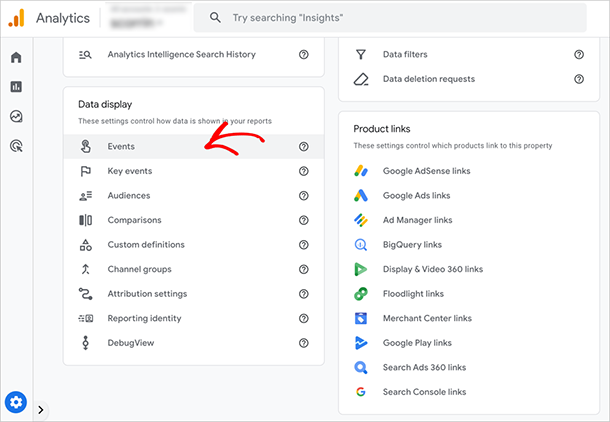
To do this, go back to the Admin cog and click “Key Events”.

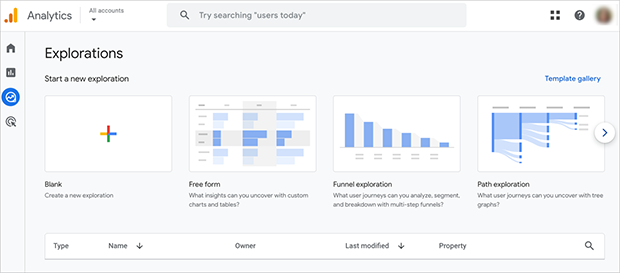
Google Analytics 4 Events

A Quick Guide to GA4 Reports

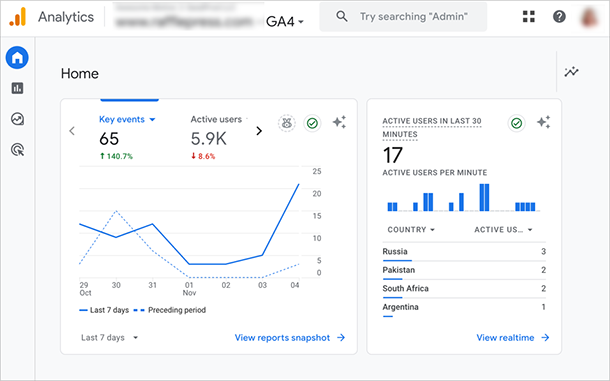
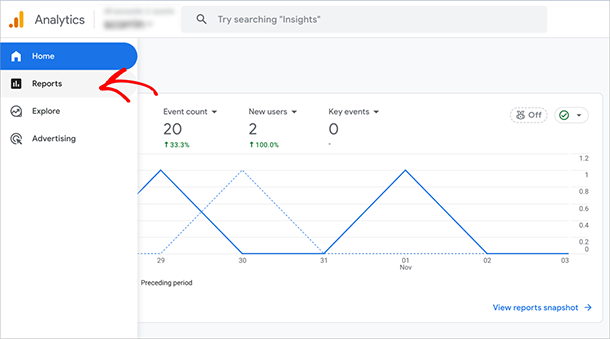
Once you’ve set up GA4, you can access its reports to understand your website’s performance. When you first log in, you’ll see the home dashboard, which gives you a quick overview of key metrics like users, new users, engagement time, and event count.

On the left-hand side, you’ll find the navigation menu. Click “Reports” to access a deeper dive into your website’s data.

Google Analytics 4 reports

Realtime Report

This report shows you what’s happening on your website right now. How many people are on your site at this very moment? What pages are they looking at?

Google Analytics 4 Realtime Overview report

This report is great for tracking the immediate impact of a new campaign or social media post.

Note: While the Realtime report works instantly, the other reports can take 24-48 hours to start showing data after you first set up Google Analytics.

Acquisition Report

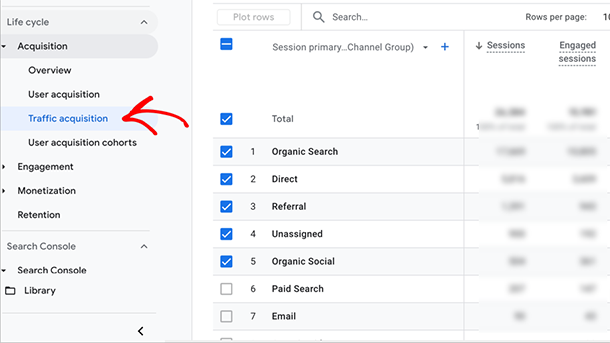
This report tells you where your visitors are coming from (Google Search, social media, other websites, or direct traffic).

Google Analytics Acquisition overview report

This helps you understand the most effective marketing efforts and where to focus your resources. If you drill down into this report, you can see which specific sources drive the most traffic to your site.

GA4 Traffic Acquisition report

Engagement Report

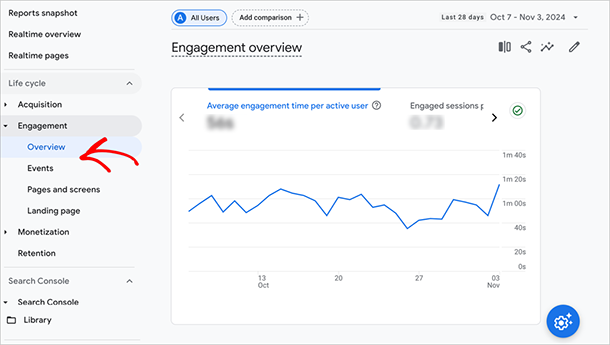
This report shows you what people are doing on your website. A key metric here is the Engagement Rate.

An “engaged session” is defined as a session that lasts longer than 10 seconds, has a conversion event, or has at least 2 pageviews. The Engagement Rate is simply the percentage of sessions that meet these criteria.

Engagement overview report in GA4

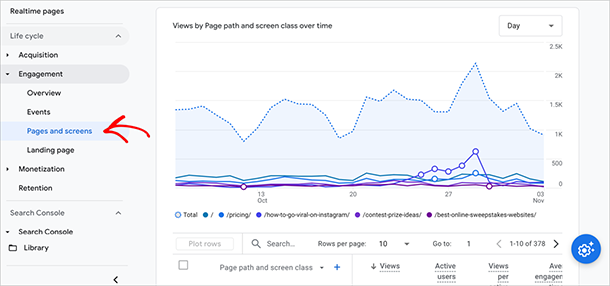
The Pages and Screens report is particularly useful here, showing you metrics for each page on your site.

GA4 pages and screens report

Monetization

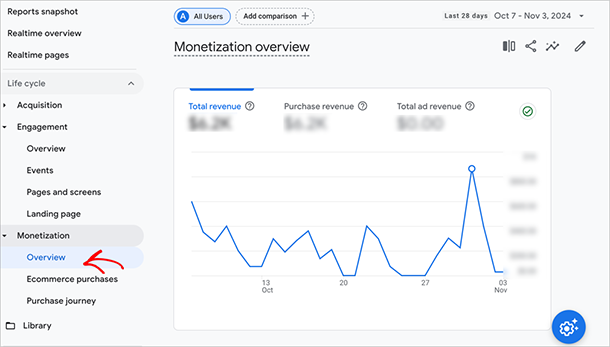
If you sell products online, the monetization report tracks sales data, revenue, and other key e-commerce metrics. To use it effectively, you’ll need to set up e-commerce tracking.

GA4 Monetization overview report

Demographics and Tech Reports

The Demographics report provides information about your audience, such as age, location, gender, and interests. 

GA4 Attributes and demographics report

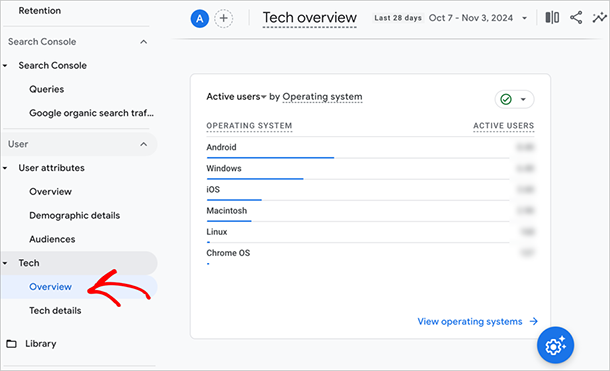
Similarly, the tech report details the technology they use to access your website, such as the device type, browser, and operating system.

GA4 tech overview report

With this information, you can tailor your content and marketing efforts to suit the type of audience interested in your business.

Now, this is a very simplified overview of how reporting works in GA4. You can find more information by digging into individual reports, parameters, and specific audiences.

However, this can quickly become confusing. That’s why, next, I’ll introduce an easier way to find the metrics that matter most to a growing business website.

Get Easy Google Analytics Reports

Many website owners wish there was a simpler way to see the most important metrics about their website’s performance without digging through complex reports and data they don’t understand. They want a clear, concise overview of what’s working and what’s not.

That’s where OnePageGA comes in.

OnePageGA - Simple, easy to use, and easy to understand one page dashboard for Google Analytics 4

It’s a simple, easy-to-use, one-page dashboard for Google Analytics 4 that brings back the simplicity and clarity of the old Google Analytics.

OnePageGA - a single page easy Google Analytics dashboard.

With OnePageGA, you see all the key metrics on a single page at a glance. No more clicking through endless reports.

You’ll see only the metrics that truly matter for growing your business so you can quickly identify what needs attention.

Setting up OnePageGA is quick and easy. Just connect your GA4 account, and you’re ready to go in minutes. No complicated settings to configure.

Connecting OnePageGA to Google Analytics

You also get pre-built Google Analytics reports designed to give you instant, actionable insights. This saves you valuable time and effort, allowing you to focus on improving your website.

FAQs About Easy Google Analytics

Is Google Analytics 4 free?

Yes, Google Analytics 4 is completely free for standard use. There is a paid version called Analytics 360, but this is designed for very large enterprises.

Is Google Analytics easy?

Google Analytics is easy once you learn the basics.
You only need to understand a few core reports like traffic, pages, and conversions to get real value. Tools like OnePageGA make this simpler because they show your top insights in plain language.

What is Google Analytics for beginners?

Google Analytics for beginners is a simple way to track who visits your site and what they do.
You’ll see where your traffic comes from, which pages get views, and which actions lead to conversions. It gives you the data you need to improve your content and grow your site over time. Tools like OnePageGA help break these reports into clear steps so you always know what to look at next.

Get Started with Easy Google Analytics

We’ve covered a lot in this guide, from setting up your GA4 account to understanding its various reports. While GA4 can be powerful, it can also be overwhelming.

Remember, the goal is to use your website data to make informed decisions and grow your business. Don’t get bogged down in the complexity of GA4. Focus on the metrics that matter most to you.

If you’re looking for a simpler, more streamlined way to access and understand your Google Analytics data, give OnePageGA a try. It’s designed to make GA4 easy, even for beginners.

Ready to get easy Google Analytics and start seeing real results?

Get started with OnePageGA today.

If you have questions or want to join the conversation, you can also find us on X.